How to Polish Motorcycle Exhaust Pipes (Including Heat Bluing)


Short answer: chrome exhaust pipes clean up well with a non-abrasive polish worked in straight passes along the length of the pipe. The part most guides leave out is that there are two entirely different problems on an exhaust, and only one of them is removable. Surface grime, road film, light rust and oxidation come off. Heat bluing, the straw, purple or blue tint near the header, is a change in the metal itself and polish will not remove it. Knowing which you are looking at before you start saves a lot of frustrated scrubbing.
The two problems, and how to tell them apart
Removable: deposits and oxidation
Road film, exhaust soot, light surface rust, water spotting and general dulling all sit on top of the chrome. They respond to polish, and the transformation on a neglected pipe can be dramatic.
The test is the same as any metal: polish a small area with a clean cloth for thirty seconds. If the cloth darkens, material is transferring and you are making progress.
Not removable: heat discolouration
The gold, straw, purple and blue banding you see close to the cylinder head is a thin oxide layer formed in the metal by sustained high temperature. It is not dirt sitting on the surface, it is the surface, chemically altered.
Polish will brighten the area around it and remove anything sitting on top, which often makes the bluing look less harsh. It will not remove it. Anything that genuinely removes heat bluing is abrasive enough to be cutting into the chrome plating, which on a pipe is thin and not something you get back.
Many riders come to like the bluing on a header. Either way, going after it aggressively is how people end up with dull, worn plating that looks worse than the colour did.
Why chrome plating needs a light touch
Chrome on an exhaust is a plated layer measured in microns, over nickel, over steel. It is hard, which is why it survives heat and road spray. It is also thin, which is why aggressive polishing is a bad idea.
Abrasive polishes work by cutting: fine grit removes the tarnished layer along with a little of the chrome. Do that repeatedly over years and the plating thins, and once it goes through you have exposed steel that will rust and cannot be repaired without re-plating.
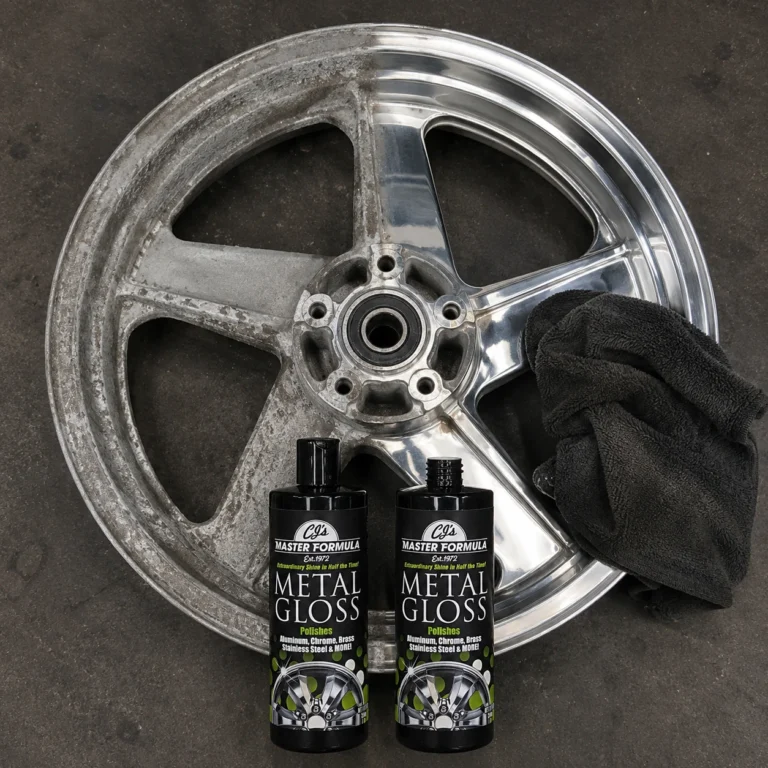
Metal Gloss uses jewelers’ rouge, the compound class used to finish precious metals where removing material is not acceptable. It lifts oxidation and rust staining off the surface rather than grinding it away, which is the behaviour you want on plating you cannot replace.
Before you start
Let the bike cool completely. This is not a formality. Polish flashing off a hot pipe is impossible to buff and can leave a baked residue that is genuinely difficult to remove. An exhaust holds heat far longer than the rest of the bike, so give it a couple of hours.
Work in shade. Same reason.
Have more cloths than you think you need. Exhausts are dirtier than any other chrome on a vehicle, and a loaded cloth stops lifting and starts dragging grit.
What you need
- Degreaser or Cleaner Gloss for baked-on road film
- A non-abrasive metal polish
- Four or five microfiber towels
- A soft detailing brush for around clamps, welds and mounting brackets
- Painter’s tape if you are working near paint, plastic or a heat shield you would rather not touch
Step by step
- Wash the pipe thoroughly. Warm soapy water and a soft brush. Get into the joins and around the clamps where grime collects.
- Degrease if needed. Exhausts collect a mix of road film, chain lube, oil mist and exhaust residue that soap will not shift. Skipping this means polishing that mixture into the chrome.
- Dry completely. Water in a clamp seam will run out later and streak the section you just finished.
- Apply polish to the cloth, a small amount at a time.
- Work along the length of the pipe, not around it. Straight passes following the direction of the pipe. Any fine marking that does occur then runs with the shape rather than ringing it, which is far less visible.
- Small sections. Roughly the length of your hand. Work it properly before moving on.
- Change cloth faces often. Exhaust grime loads a towel quickly.
- Buff with a clean dry microfiber until the pipe reflects sharply.
- Repeat where needed. A pipe that has not been touched in years will take two or three passes.
- Seal it. Covered below, and on an exhaust it matters more than most places.
The awkward areas
Around clamps and brackets
Grime packs into the gap between clamp and pipe. A soft brush first, then a folded corner of microfiber pushed into the seam. A flat pad only touches the high points.
The underside
The side facing the road takes the worst of the salt and stone chips and is where rust usually starts. It is also the side nobody polishes. If you are going to the effort, get underneath.
Heat shields
Often a different material to the pipe, sometimes brushed stainless or aluminum rather than chrome. Check what you are working on and treat it accordingly.
Welds and joins
Chrome is thinnest over a weld bead because of how plating flows. Go gently there, and do not concentrate repeated passes on a weld.
Rust on an exhaust: what is realistic
Light surface rust, the orange bloom that has not yet gone deep, lifts with polish. That is the common case on a pipe that has been rained on and left.
Pitting is different. Once rust has eaten into the plating and the steel beneath, the metal is physically gone. Polishing will clean the pits and remove the staining around them, which makes the damage far less noticeable, but the pits stay. No polish adds material back.
Run a fingernail across the affected area. If it catches, the rust has depth and a rust remover is needed before polishing. If it feels smooth, polish will handle it.
We covered this distinction in more detail in will metal polish remove rust.
Sealing an exhaust
Freshly polished chrome on an exhaust faces a harder life than chrome anywhere else on a vehicle: heat cycling, road spray, salt in winter, and stone chips.
Applying Sealer Gloss after polishing puts a barrier between the chrome and all of that. On a bike stored outside or ridden through winter, this is the difference between polishing once a season and polishing every few weeks.
Apply it to a cool pipe and let it set before riding.
Keeping pipes looking right
- Wash salt off promptly. Salt sitting on chrome through a winter is the single most damaging thing that happens to an exhaust.
- Dry after washing. Water standing in a clamp seam is where rust starts.
- Polish every two to three months to catch a light film rather than an established problem.
- Do not cover a wet bike. A cover over damp chrome traps moisture against it and accelerates exactly what you are trying to prevent.
Frequently asked questions
How do you polish motorcycle exhaust pipes?
Let the pipe cool completely, wash and degrease it, then work a non-abrasive polish along the length of the pipe in straight overlapping passes with a microfiber cloth. Buff off with a clean towel, repeat on heavily oxidised areas, and seal the finish afterwards.
Can you remove heat bluing from chrome pipes?
Not with polish. Heat discolouration is an oxide layer formed within the metal by high temperature, not a deposit on the surface. Polishing brightens the surrounding chrome and reduces how harsh the colour looks, but removing bluing outright requires abrasives aggressive enough to damage the plating.
Will polish remove rust from an exhaust?
Light surface rust, yes. Pitted rust that has eaten into the metal, no, because polishing removes a layer and pitting is missing material. Run a fingernail over it: if it catches, use a rust remover first, then polish.
Can I polish a hot exhaust?
No. Let it cool completely. Polish applied to a hot pipe dries almost instantly, becomes very difficult to buff off, and can leave baked residue that is harder to remove than what you started with.
Is it safe to use metal polish on chrome plating?
With a non-abrasive polish, yes. Abrasive compounds cut into chrome plating, which is only microns thick on an exhaust and cannot be replaced without re-plating. A jewelers’ rouge formulation lifts oxidation without removing plating.
What about stainless or titanium exhausts?
Stainless polishes well with the same product, though it should be worked along any visible grain. Titanium and ceramic-coated systems are different surfaces entirely, and you should check the manufacturer’s guidance before applying anything.
How often should I polish my exhaust?
Every two to three months keeps chrome bright with minimal effort once it has been restored and sealed. A bike ridden through salted winters needs attention as soon as the season ends.
Why does my exhaust go dull again so fast?
Usually because it was not sealed. Bare polished chrome on an exhaust faces heat, road spray and salt, so it dulls quickly without a protective layer. Sealing after polishing holds the finish for months.
Getting started
Cool pipe, clean first, straight passes along the length, and seal when you are done. Accept the heat bluing near the header rather than fighting it, and concentrate your effort where polish actually works.
If you are doing a whole bike, the Metal Gloss 2-Pack saves 10% over buying twice, and our bundles pair polish with Sealer Gloss so the finish lasts through the season.