How to Polish Chrome Bumpers Without Scratching Them

Short answer: to polish chrome bumpers without scratching them, wash and dry the bumper first so no grit remains, use a non-abrasive polish rather than an abrasive compound, work in small sections with a clean microfiber cloth, and switch to a fresh towel as soon as the first one loads up with residue. Almost every scratch people put into chrome comes from one of two things: dirt left on the surface, or an abrasive product doing the cutting.
Chrome is more forgiving than aluminum, but it is also unforgiving in a specific way. When you scratch chrome, you cannot polish the scratch out, because chrome is a thin plated layer over steel. Take too much off and you are through to the base metal. So the goal is not to fix scratches afterwards. It is to not create them.
Why chrome scratches in the first place
Chrome plating on a bumper is measured in microns. It is hard, which is why it resists scratching in daily use, but it is thin, which is why aggressive polishing is risky.
Two things put marks into it:
Trapped particles. Road grit, brake dust and sand are harder than most people assume. Dragging a cloth over a dirty bumper turns every one of those particles into a cutting tool under your hand. This is the single most common cause of swirls in chrome, and it has nothing to do with the polish.
Abrasive compounds. Many metal polishes work by cutting: fine abrasive grit removes the tarnished surface layer along with a little of the chrome. It produces fast results and a pattern of fine scratches that show up as haze in direct sunlight. On thin plating, repeated use over years thins the chrome.
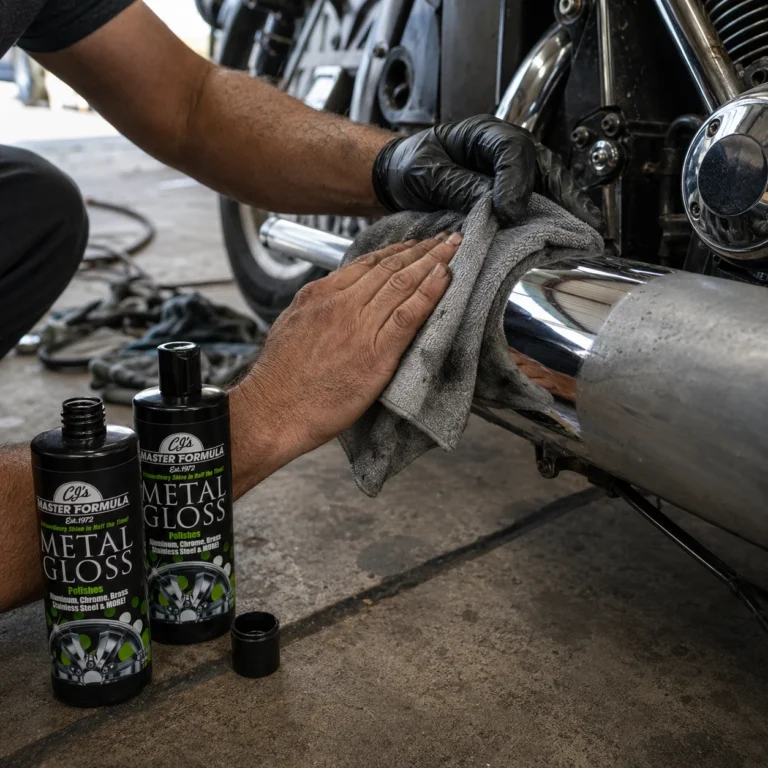
This is why CJ’s Metal Gloss is built on jewelers’ rouge rather than abrasive grit. Jewelers’ rouge is what is used to finish precious metals, where removing material is not acceptable. It lifts oxidation and tarnish off the surface instead of grinding it away, which is the behaviour you want on plating you cannot replace.
What you need
- Car soap, water and a hose
- Three clean microfiber towels, minimum
- A non-abrasive metal polish
- A foam applicator pad, optional
- A sealant for afterwards
Note what is not on that list: steel wool, scouring pads, household cleaners and sandpaper. All of these appear in advice online, and all of them will damage chrome plating.
Step by step
1. Wash the bumper thoroughly
Not a wipe. A proper wash with soap and water, working into the edges and the back face where grit collects. Rinse fully.
Pay attention to the bottom edge of the bumper, which catches the most road spray and holds the most grit.
2. Dry completely
Any water left in a seam will run out mid-polish and streak the section you have finished. Dry with a clean towel and give it a few minutes.
3. Check what you are dealing with
Run a hand over the surface. If it feels rough or gritty after washing, there is bonded contamination that a wash will not shift, usually baked-on road film or brake dust.
Polishing over that means grinding it into the chrome. Use Cleaner Gloss first to lift the contamination, then polish. Asking a polish to do a cleaner’s job is where a lot of avoidable scratching starts.
4. Apply a small amount to the cloth, not the bumper
Put the polish on a folded microfiber or a foam applicator. Applying directly to the bumper wastes product and gives you uneven coverage.
A small amount is genuinely enough. Overloading makes the buff-off harder and does not clean faster.
5. Work in small sections with firm, straight passes
Take an area about the size of your hand. Use firm, overlapping passes in a straight line rather than circles.
Straight passes matter for a practical reason: if you do end up with any fine marks, straight-line marks are far less visible than circular swirls, which catch light from every angle.
The cloth will darken as tarnish and oxidation transfer off the bumper. That is what you want to see.
6. Change cloths as soon as they load up
This is the step people skip and it is the one that causes scratches late in the job.
Once a towel is saturated with black residue, it stops lifting and starts dragging that residue back across the surface. Fold your towel to a clean face, and when you run out of clean faces, get a fresh towel.
7. Buff off with a clean, dry microfiber
Buff until the surface runs clear and reflects sharply. If it looks hazy, there is still polish residue on the surface, so keep buffing with a clean face.
8. Seal the finish
Freshly polished chrome is clean, bare and exposed. Applying Sealer Gloss puts a protective layer between the chrome and the road, which slows the return of oxidation and makes the next wash do more of the work.
On a vehicle that lives outside or sees winter salt, this is the difference between polishing twice a year and polishing every few weeks.
Pitted chrome: what is realistic
Pitting is where chrome has failed and corrosion has come through from the steel underneath. It shows as small craters or rough patches, often starting at edges and seams.
Here is the honest position: polish will not fix pitting. Pitting is missing material, and no polish adds material back.
What polishing will do is clean the surrounding chrome, remove the rust staining around the pits, and make the damage considerably less obvious. On a driver-quality classic that is often exactly what people want.
What it will not do is return a pitted bumper to show condition. That requires re-plating, which is a specialist job.
If a bumper is pitted, polish it and seal it. The sealing matters even more here, because the exposed steel in the pits will keep corroding if left open to the weather.
Bumper trim, badges and surrounding paint
Metal Gloss is formulated for metal, and it is safe if it makes contact with paint during a job. You do not need to mask off the bodywork.
That said, for painted surfaces themselves, Xtreme Gloss is the right product. Polish the chrome, then deal with the paint separately.
Around badges and in tight seams, a folded corner of microfiber pushed into the gap works better than a flat pad, which only touches the raised surface.
How often to polish chrome
Every two to three months keeps chrome bright with minimal effort. Once the finish is established and sealed, maintenance passes take a fraction of the time of the first restoration.
Adjust for conditions. A show car under cover needs it rarely. A daily driver through a salted winter needs attention as soon as the season ends, because salt left on chrome over months does real damage.
Frequently asked questions
What is the safest way to polish chrome?
Wash and dry first so no grit remains, use a non-abrasive polish, work in small sections with firm straight passes on a clean microfiber cloth, and change to a fresh towel as soon as one loads with residue.
Can you polish chrome by hand or do you need a machine?
By hand is fine and is what we recommend on bumpers. A cloth or foam applicator gives better feel for pressure and better control around edges, badges and curves.
Will metal polish remove scratches from chrome?
It removes light surface scratches and greatly reduces fine swirl marks. Deep scratches that have gone through the plating cannot be polished out, because the chrome layer is too thin to remove material from safely.
Can I use steel wool on chrome?
No. Fine steel wool will scratch chrome plating and leaves steel particles behind that rust in place. Use a microfiber cloth and a non-abrasive polish instead.
Why does my chrome look hazy after polishing?
Almost always leftover polish residue rather than damage. Buff again with a clean, dry microfiber.
Does chrome polish work on chrome-effect plastic?
Chrome-effect plastic trim is a thin metallic coating over plastic and is far more delicate than plated steel. Test on a hidden area first and use very light pressure.
How do I stop chrome tarnishing again so quickly?
Seal it. Sealer Gloss protects the finish for up to six months depending on conditions and how the vehicle is stored.
Getting started
The technique is simple and the product choice does most of the work. Wash first, use something non-abrasive, keep your towels clean, and seal when you are done.
If you are working through a full vehicle, the Metal Gloss 2-Pack saves 10% over buying two singles, and our bundles pair polish with Sealer Gloss so you can finish the job properly in one go.
For a broader walkthrough covering all chrome rather than bumpers specifically, see our guide on how to polish chrome.
For chrome exhaust work, see how to polish motorcycle exhaust pipes, which covers what to do about heat bluing.